Sunday, March 4, 2018

On to Collier-Seminole SP

On February 25th, we checked into Collier-Seminole State Park. This SP was not well laid out or maintained.  We did ride our bikes a few different times because they had a bike path ~3 miles long so out and back was ~6 miles.  We think one of the keys to enjoying our time is exercise and eating well.  After all aren't peanut M&M's part of everyone's food pyramid?  There was something quite interesting at CSSP.  It was a walking dredge used to build the Tamiami Trail.  This engineering marvel piece of machinery was built in Bay City, Michigan and could 'walk' through the swamps covering 10' per stride.  It had wide 'feet' and a cable system that would pull one side forward then the other.  So they used it to dredge the swamp and pile up the material to create a road bed that is U.S. 41 today.

After leaving Collier-Seminole SP, we lumbered along up to Lake Manatee SP near Bradenton, FL. where we are staying for four nights.  While here, we went to the DeSoto National Monument and were quite surprised at what a wonderful and historical place this is.  When Bonnie was teaching 4th grade, she taught about DeSoto and was describing the details to me as we were walking through the monument.  DeSoto was a vile, ruthless explorer, using dogs to attack the Indians.  There were life size pictures of DeSoto's group as well as the Indians he captured and forced into labor.


 DeSoto's camp pictured above


Every Alabama 4th grade teacher would know this story.  (Right Rachael?)

The walking trails on the monument grounds was really nice and shaded.

We did get to see some unusual animals during our visit.


We then took our bikes to another place close by that had some beautiful trails to bike.


We had a real nice campsite in Lake Manatee SP.  Site 44 was very large, level, and surrounded by fan palms.


There were several places to ride our bikes inside the park, so as we were exploring, we came upon another one of these guys.  Granted, they are not as much fun as alligators.


We leave Lake Manatee SP tomorrow, March 5th, to go to Manatee Springs SP, hoping to stop and ride our bikes on a rails-to-trails trail.


Tuesday, February 27, 2018

North side of Everglades NP

We left the southern tip of Everglades NP on Wednesday, February 21, and stayed at Midway campground on the Tamiami Trail, US Hwy. 41.  This was a delightful small campground with all campsites paved and facing the small lake.  It was still in the Everglades NP so people who have had a respectable number of birthdays camped for $15/night with the National Park Pass.


February 22

We drove back down the road to Shark Valley, another place inside Everglades NP, with a paved bike path down along a canal filled with alligators and water birds.  We biked about 10 miles and were able to view several alligators and birds.

Young alligator
 Baby Anhinga birds


 Night heron

Great Blue heron above and Tricolored heron below

Great Blue heron eating a fish we saw him catch

February 23

We decided to go back and ride our bikes again but a little further this time.  We rode ~15 miles down to the end of the loop where there is an observation tower allowing you to see across the Everglades, then back to the visitor center.  On the way out to the tower, we saw an alligator inside a culvert pipe apparently waiting for some fish to pass through.

 Approaching the tower

  From up on the tower

We saw 55 alligators from the tower back to the visitor center. 

 February 25

We left Midway campground and meandered towards Collier-Seminole State Park.  On the way, Bonnie mentioned she needed a post office if we saw one.  About ten miles further down the road we not only found a post office, we found the smallest post office in the United States.
 That's right, the small white building IS the post office.

We continued on to Everglades City, a small, town with lots of buildings in disrepair.  We got tickets to take an air boat ride in the mangrove swamps, an air boat ride in the grass land swamps, and a swamp buggy ride.


We are not on this buggy.


We will be here for a few more nights before heading to our next destination.


Monday, February 26, 2018

Everglades National Park


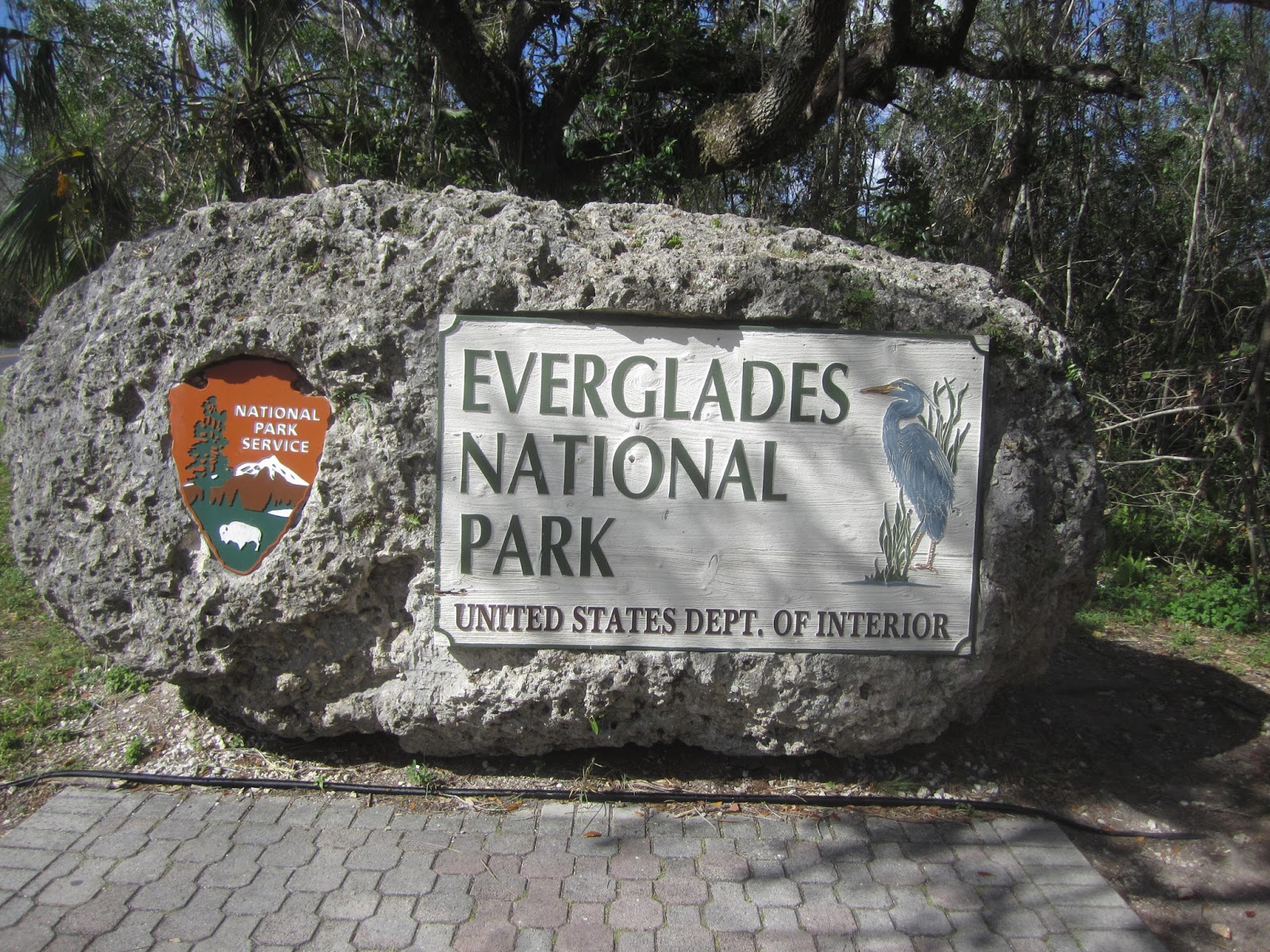
On Wednesday, February 14, we entered Everglades National Park where the entrance is near Homestead, FL.  The distance from the park entrance to Flamingo, FL is ~40 miles.  We stopped at Long Pine Key Campground where the road and the campsites were level and paved. The campsites did not have water or electric, but it did have very clean bath houses. 


February 15-21


The next morning, we continued on down to Flamingo stopping at the Royal Palms area to walk around the Anhinga Trail and the Gumbo Limbo Trail.  In the event you are not familiar with the Anhinga, it is a unique water bird that dives then can swim with just its head out of the water.  Then, it dries its feathers by perching in a tree and spreading its wings for the sun to dry it.  Unlike other birds, it does not have natural oil in its feathers.  I did not get a picture of it because it was too far away.  But, I did get a reasonably close picture of the Cormorant, pictured below, another water bird that also dives and can stay under water for a lengthy time.


Another interesting bird on this trail was the Purple Gallinule.  It walks on top of the lily pad type of water plant searching for food, but he is very quick so I did not get a picture of him, so I took a picture of the posted placard. 


As we continued walking, we came upon a few alligators that are always fun to see.


After we finished the Anhinga Trail, we walked the Gumbo Limbo Trail.  The Gumbo Limbo is a tree native to this area whose bark can be bright red.  The Gumbo Limbo tree (pictured below) was used for carving carousel horses and the bark was brewed for the flavoring of gumbo soup/stew.


There were hundreds of these Anoles and they didn’t seem to mind how close we got to them.


Something I find fascinating is the Strangler Fig.  This vine wraps itself around other trees, sends its roots to the ground and heads for the sky, killing the tree it wrapped around.


We continued on down to the Flamingo Visitor’s Center right on the Florida Bay.  The condition of this place is pretty bad due to hurricanes in the past, and most recently Irma.  There were a lot of things broken or destroyed and they have not yet recovered.  In the picture below, we are standing on the breaker wall looking out over the Florida Bay.


The wildlife is just now starting to recover and we saw several of the Red Shouldered Hawks pictured below.


On the breaker wall there was a fresh water drain where the gentle Manatee came up and kept his mouth pressed against for the water.


The Flamingo, FL area is an interesting place.  According to the rangers here, this is the only place in the world that is inhabited with both alligators and crocodiles. We saw this crocodile on the boat launch ramp.  Notice how much lighter in color the crocodile is compared to the alligator above and how much narrower his snout is than the alligator snout.

We participated in a ranger lead activity on Saturday, February 17.  This free activity was taking a canoe trail through the mangrove trees.
 
 
Notice how clear the water is.


Again, the clear water.


I have to admit, the Everglades is nothing like what I expected.  I expected nothing but swamp and lots of insects, but I was totally wrong.  The Everglades is mostly prairie grass that filters an eight mile wide fresh water river, and its tributaries.  Due to all the grass filtering this slow moving river, the water is unbelievably clear.  There are plenty of insects, but during our visit, the mosquitoes were a non-issue.  Here is a picture of the prairie grass and if you look closely, you can see the water.

We are leaving the southern tip of Everglades National Park on February 21st.